At the heart of things instead of on the periphery (“Mittendrin statt nur dabei”):
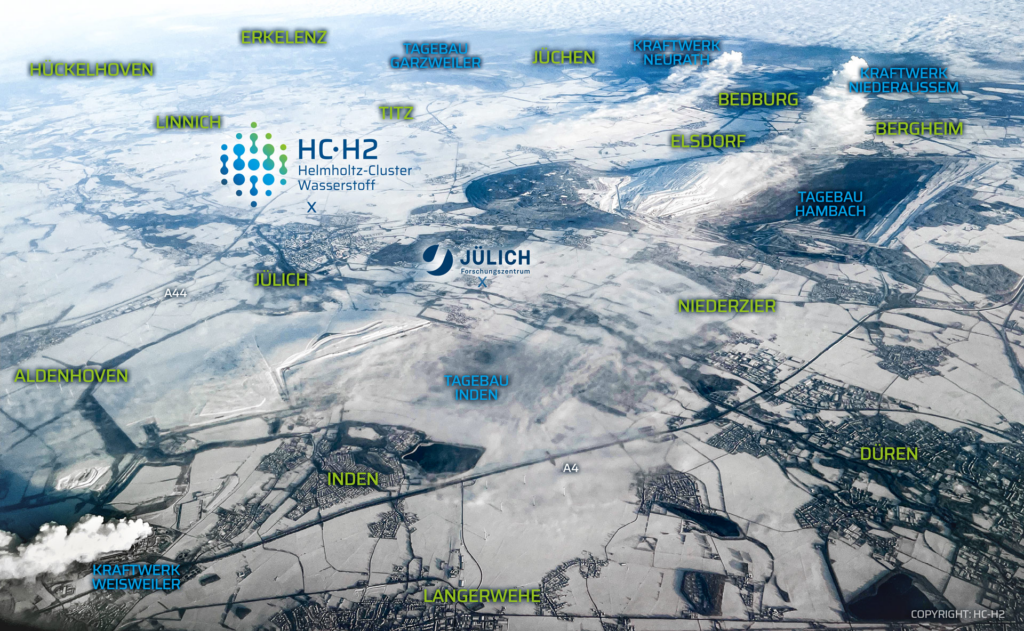
this was a famous advertising slogan used by a German TV sports channel. This slogan also holds for the Helmholtz Cluster for a Sustainable and Infrastructure-Compatible Hydrogen Economy (HC-H2). The town of Jülich, Forschungszentrum Jülich, and the cluster are all situated in the heart of the Rhenish mining area, which is currently covered in a blanket of snow. This is clear to see in a photo taken of a section of the region from an altitude of 6,000 metres (see interactive image below). The Inden and Hambach open-cast mines can be clearly identified in the photo. We can also imagine where we would find the two cavities of the Garzweiler open-cast mine, where today the A44 motorway runs through the middle. For decades, the region has been characterized by its open-cast lignite mines and power plants; lignite ensured prosperity and security of supply. However, it is also part of the problem of global warming, because greenhouse gases are released into the atmosphere during mining and electricity generation.
At the heart of things instead of on the periphery (“Mittendrin statt nur dabei”): this slogan also makes sense with a view to the energy transition, a process that has started due to a decision taken to phase out lignite-based electricity generation. And this will happen sooner than originally planned. Instead of 2038, coal will no longer be mined in the Rhenish mining area from 2030; job cuts are already necessary. The Rhenish mining area needs to reinvent itself to ensure that the phasing out of lignite leads to successful structural change as opposed to a structural break. We are currently in the middle of this process, which we aim to successfully implement throughout the entire region.
Our common goal must be to transform the Rhenish mining area from an energy exporter to an exporter of environmentally friendly energy technologies of the future. In contrast to lignite, which still makes up a proportion of the base load of the energy supply in Germany, the technologies produced here in future between the former open-cast mines can be exported all over the world. In this context, our Helmholtz hydrogen cluster is helping to establish a fundamental pillar: the use of hydrogen as an energy storage technology of the future. Our goal for a future version of the photo taken below: imagine that the photo has been taken by an aeroplane powered by environmentally friendly fuels and that it shows a former lignite mining region that is not only at the heart of – but is also a world leader in – developing and exporting affordable, environmentally friendly energy technologies.
An important note: this photo was taken by chance; the section imaged could not have been chosen any other way. This is why certain towns and municipalities of the Rhenish mining area cannot be seen in the photo.
The copyright for the images used on this website is held by Forschungszentrum Jülich, aligator kommunikation GmbH and
stock.adobe.com.