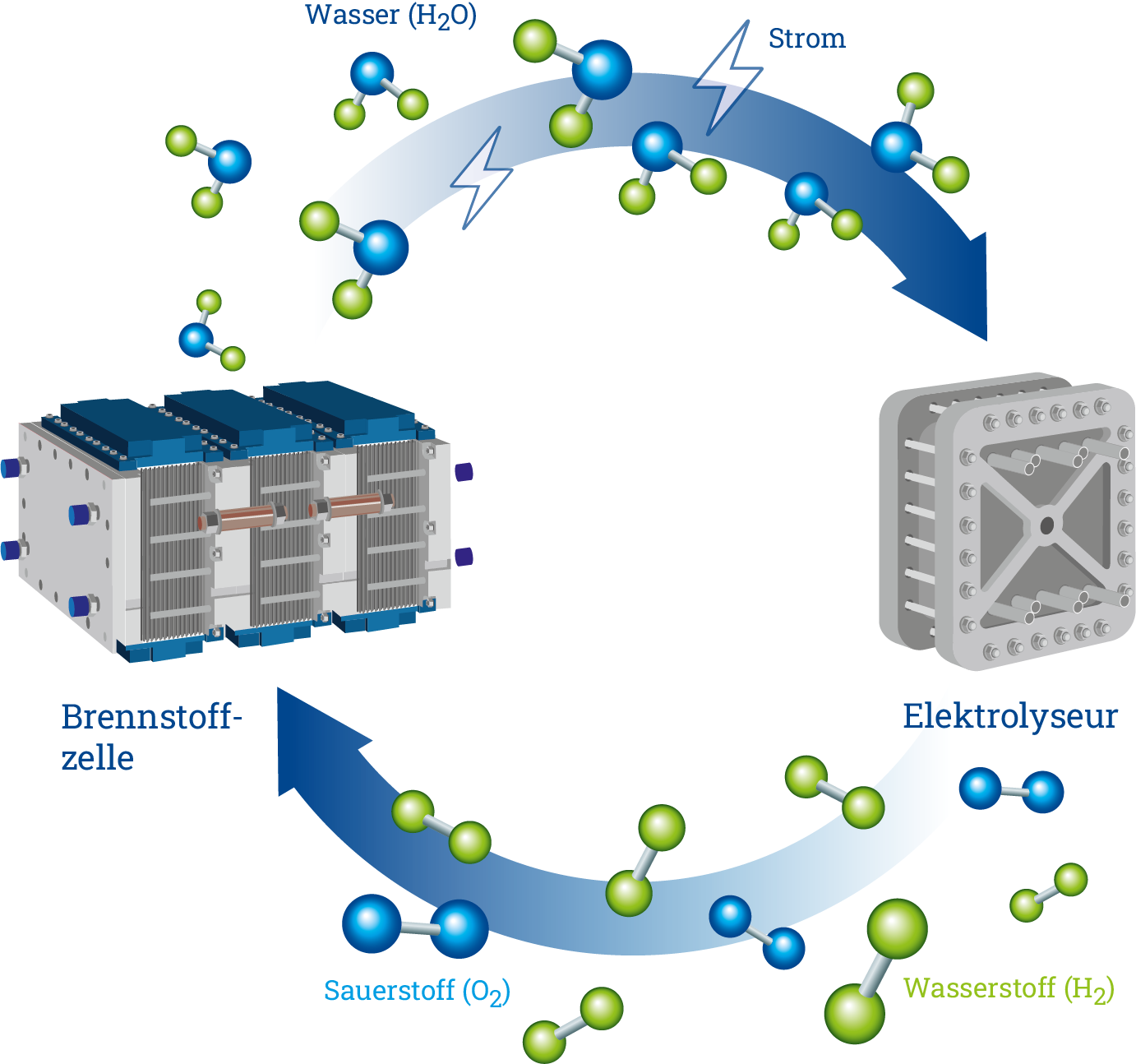
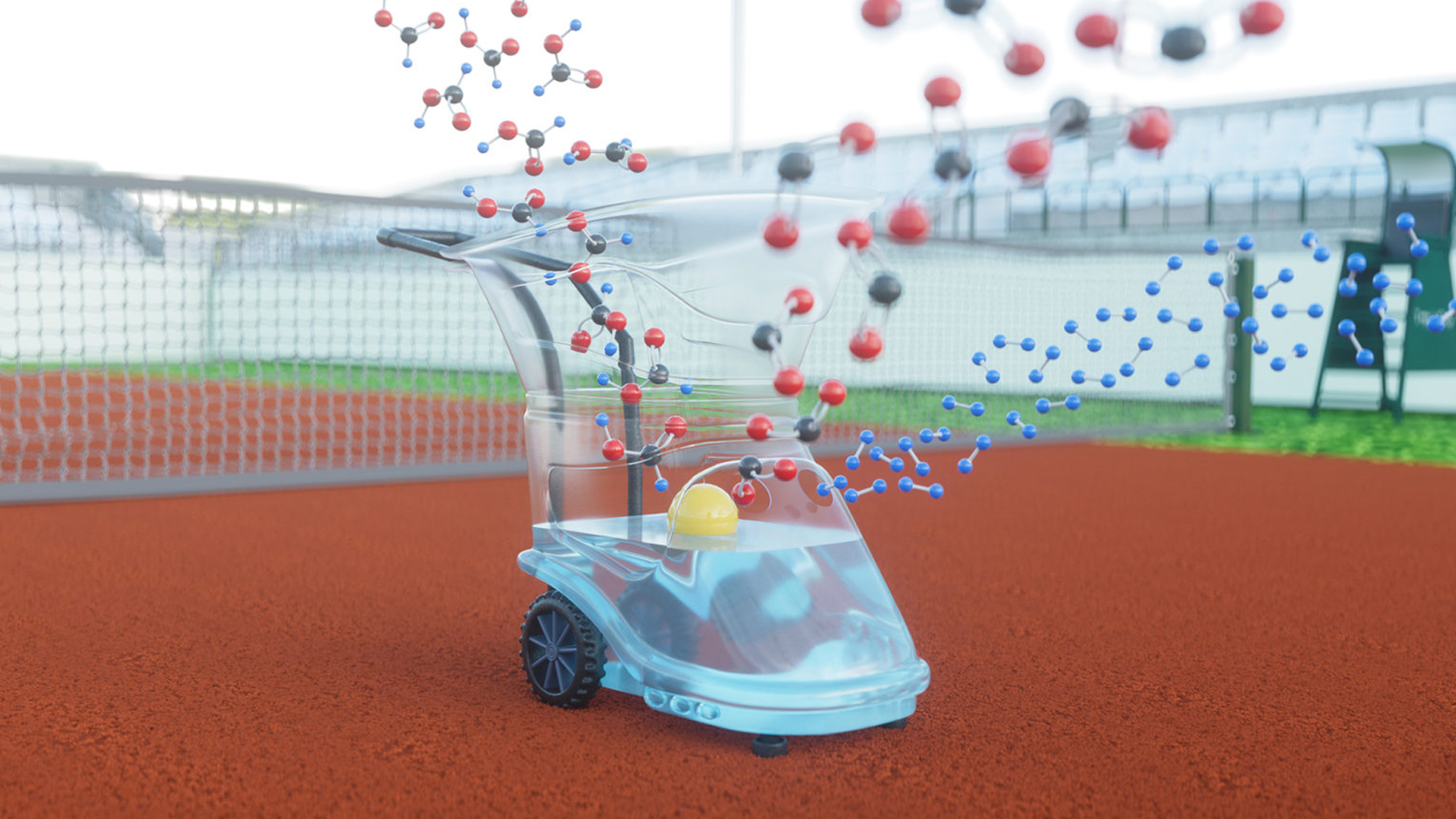
Yin and Yang: These are fuel cells and electrolysers for the world of hydrogen. Graphic: AdobeStock
Electrolysers and fuel cells are like the yin and yang of the hydrogen world. They represent two processes that are opposite yet perfectly complementary. An electrolyser uses electrical and thermal energy to split water (H2O) into hydrogen (H2) and oxygen (O2). The fuel cell then reverses the process: hydrogen and oxygen react to form water. During the reaction, a large proportion of the electrical energy required for electrolysis is recovered. So far, so simple.
energy converter
Both principles have been known since the first half of the 19th century. Since climate research began to find increasing evidence in the late 1980s that humans are disrupting the natural balance of the climate by burning fossil fuels such as coal, oil and gas, scientists have been working intensively to develop energy storage and conversion technologies that will not further destabilise the climate. Electrolysers and fuel cells are two crucial technologies that are necessary for hydrogen to become a pillar of the climate-friendly energy system of the future alongside batteries.
PEM systems
The PEM electrolyser and the PEM fuel cell – PEM stands for proton exchange membrane – are still relatively new. And they offer hope for the hydrogen economy of the future. ‘They have good load flexibility,’ says Dr Holger Janßen, group leader for stacks and systems at the Institute of Energy Technologies (IET-4) at Forschungszentrum Jülich, describing a major advantage of PEM technology. ‘This means they can cope well with highly fluctuating electricity supplies. They can also be run at partial load when little green electricity is available.’ This is important for the green energy economy of the future, which is to be supplied with renewable energy. And that is not available in constant quantities because the sun does not always shine and the wind does not always blow.
The most expensive metal in existence
However, electrolysers and fuel cells with proton exchange membranes remain a challenge for research. “The membrane electrode assembly, the heart of every PEM cell, consists of critical, expensive materials,” explains Holger Janßen, referring primarily to the metal iridium, which is a bottleneck for electrolysis. Platinum is used in PEM fuel cells – also expensive, but less critical than iridium. “Since it became clear that we want to produce more hydrogen and that PEM electrolysis will play a major role in this, the stock market price for iridium has risen dramatically.” By more than 800 percent in the past ten years. One troy ounce (31.1 grams) of iridium currently costs more than €4,200. By comparison, gold was trading at around €2,150. “Even for us, who only need small quantities for scientific purposes, this is a problem,” explains Holger Janßen.
Fuel cells and electrolysers are energy converters that transform electricity into hydrogen – and back again. Graphic: Forschungszentrum Jülich/Reisen
Less than ten tonnes per year
The reason for the dramatic increase that occurred at the end of 2020 is the rarity of iridium compared to the rapidly increasing demand. Natural deposits are minimal. Iridium accounts for only 0.022 billionths of the Earth’s crust. The deposits are thought to be the result of an asteroid impact that wiped out most dinosaur species 66 million years ago. However, iridium can still be extracted as a by-product of platinum production. Nevertheless, the amount extracted worldwide – less than ten tonnes per year – is significantly lower than demand, which exceeds 200 tonnes.
PEM electrolysis technology requires a gas-tight membrane to separate the anode and cathode areas of the cell. It operates in an acidic environment. It is therefore important that the materials do not rust. No metal rusts as little as iridium. In contrast to alkaline electrolysis, in which a negative ion migrates from the cathode to the anode, the ion transport here is different: a positive hydrogen ion migrates through the proton-conducting membrane from the anode to the cathode. The result is the same: oxygen collects at the anode and hydrogen at the cathode. Everything is exactly the same, only the other way round – that’s how the PEM fuel cell works. Hydrogen and oxygen are converted back into water. “We are already very familiar with PEM fuel cells from their use in applications such as cars, trucks and buses,” explains Holger Janßen. The technology is now so advanced that it has made the leap into application and series production. Mobile applications also demonstrate the strength of PEM technology: it can be used in small, decentralised units. And it is robust because it can withstand vibrations and shocks.
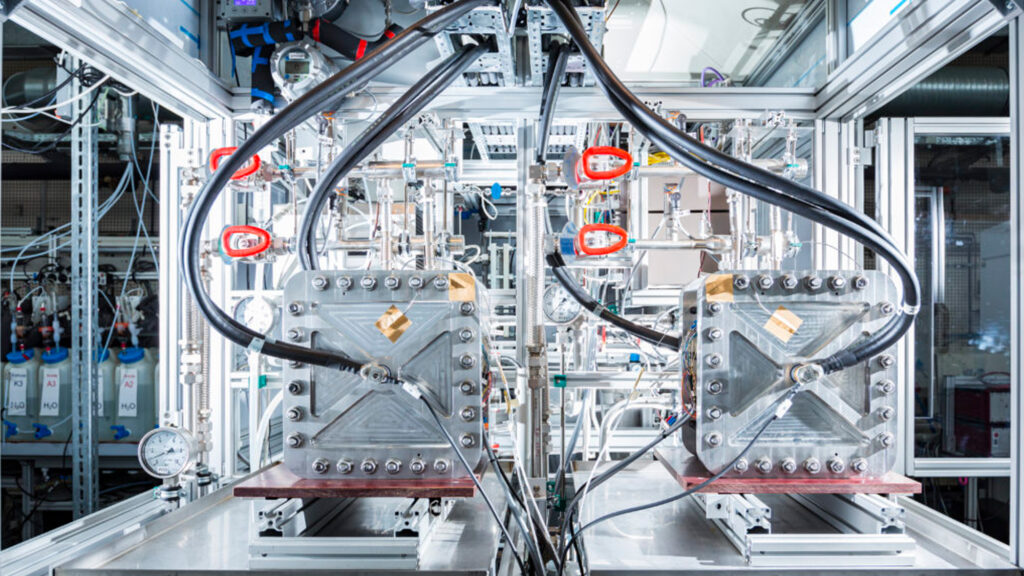
Electrolysers play a central role in the hydrogen economy of the future. Photo: Forschungszentrum Jülich/Limbach
The best of both worlds
Holger Janßen sees the fastest possible route to a climate-friendly future, in which hydrogen plays a key role alongside battery storage, in the interaction of two electrolysis technologies. “In principle, this is comparable to fossil fuel energy production: coal-fired power plants are used to provide the necessary base load. And the dynamic peaks are served by gas-fired power plants. In the future, large alkaline electrolysers could provide the base load. The technology is proven, relatively inexpensive and can be scaled up at reasonable cost. PEM electrolysers can then cover the peaks. They are flexible in terms of load and can be ramped up and down quickly.” This basically applies to both types of electrolysers. This is because they operate at relatively low temperatures in the range of 50 to 80 degrees Celsius. This does not place any additional demands on the material. Furthermore, the electrolysers do not need to be insulated at great expense. This is in stark contrast to high-temperature applications.
Another avenue being pursued, not only by researchers in Jülich, is to combine alkaline electrolysis and PEM electrolysis. Not by using them side by side, but by actually combining the properties of both technologies to create a new one.
Anion exchange membrane (AEM electrolysis, anion exchange membrane) is the name of the new method in which, unlike PEM electrolysis, no protons migrate to the cathode with the aid of a membrane, even though the electrolyser is constructed like a proton exchange membrane system. Instead, an anion migrates to the anode, as in alkaline electrolysis.
The advantage that scientists hope to achieve is that iridium will no longer be necessary and will be replaced by nickel. Nickel is cheaper than iridium and available in larger quantities. “There are no large-scale AEM systems available yet, only smaller demonstrators. So it will be some time before this technology is available on the market. But we are confident that AEM electrolysers will play an important role in the 2030s,” says Holger Janßen optimistically.
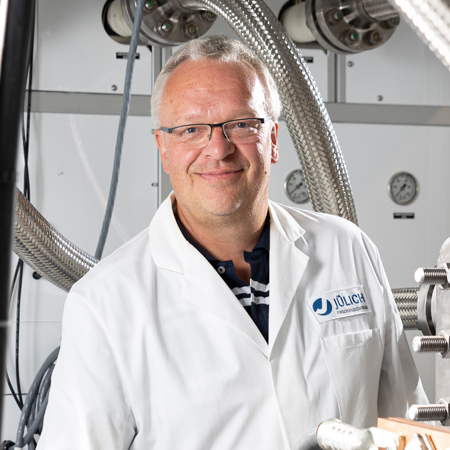
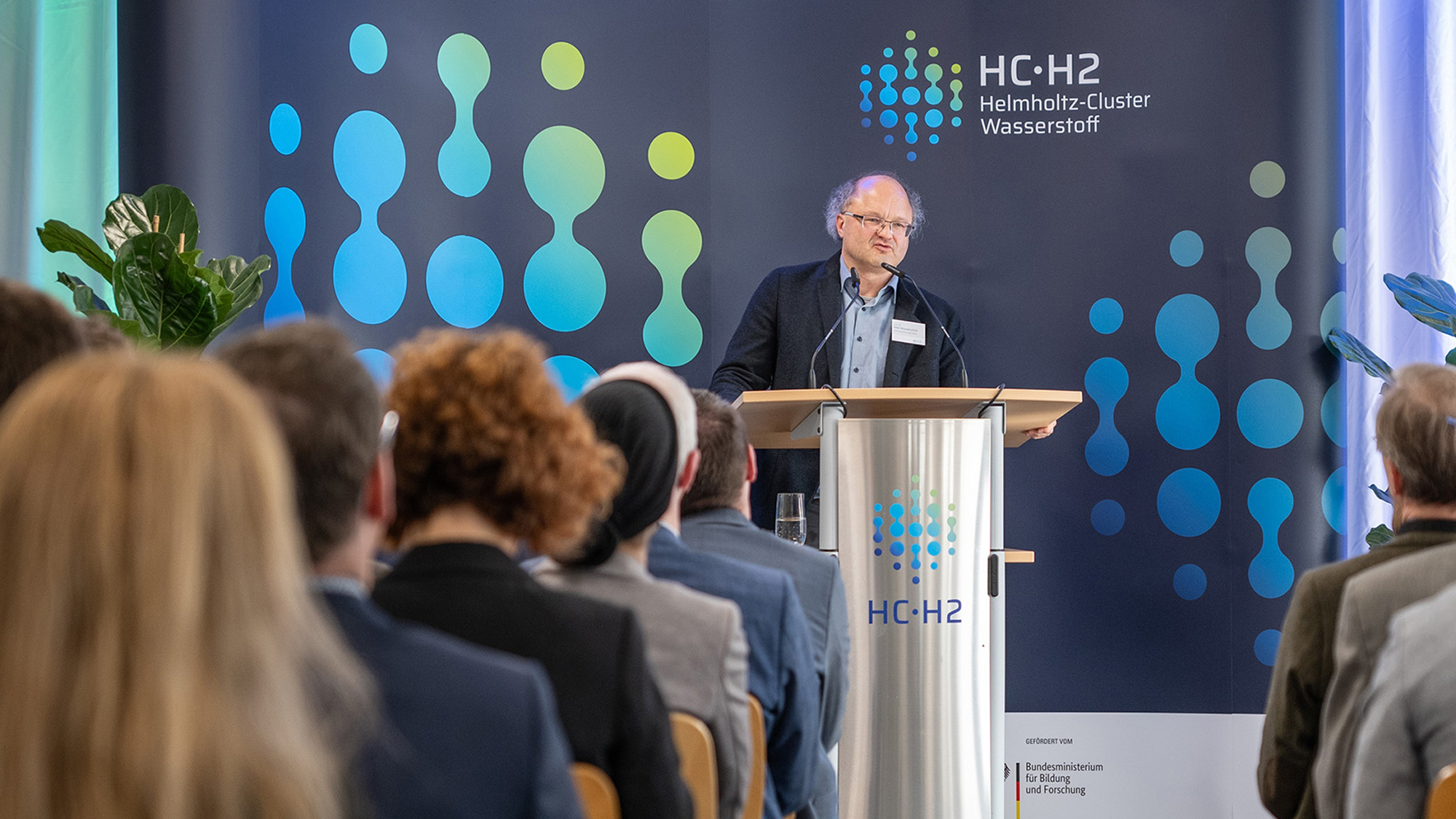
Dr Holger Janßen, Group Leader for Stacks and Systems, Institute of Energy Technologies (IET-4)
Research into solid oxide systems that operate at high temperatures is far from complete. There are SOEC and SOFC systems. SOEC stands for solid oxide electrolysis cell. SOFC stands for solid oxide fuel cell. The systems are now being used on an industrial scale, for example in the HC-H2 demonstration project Multi-SOFC at Erkelenz Hospital. The high temperatures at which the systems operate have long been a challenge for researchers. They range between 500 and 1,000 degrees Celsius. “Solid oxide reactors start at ambient temperature and then heat up significantly. This affects the material because it expands greatly and can be damaged,” says Holger Janßen, describing the challenge that the research team had to overcome. Nevertheless, the effort is worthwhile. “Solid oxide systems make sense where high temperatures are already present or can be easily extracted.”
High-temperature applications
This makes sense in many industrial environments, for example. High-temperature energy converters achieve the highest efficiency levels, which means that the most electricity can be drawn at the end of the process. They are also the only hydrogen technology that can guarantee both a supply of electricity and heat. “High-temperature systems make sense where they can run as continuously as possible. Frequent start-up and shutdown takes too long due to the high temperature required,” says Holger Janßen, describing the scenarios that come into question. A second prerequisite is that high-temperature cells only make sense for applications where they are exposed to as little vibration as possible. “Ceramics are used here, which are relatively brittle and become damaged if exposed to too much vibration.” This means that the technology is not suitable for cars and trucks, for example. For larger ships, on the other hand, it makes more sense.
Die Technologien ergänzen sich
“Research will continue to make improvements in high-temperature applications and PEM technology in the future. This will make the technology cheaper and more efficient. However, the technologies available today for electrolysers and fuel cells are already capable of meeting the demand necessary for hydrogen to become an important part of the climate-friendly energy economy of the future,” says Holger Janßen. He also draws a second important conclusion: “Hydrogen is part of the future of energy storage and complements battery storage perfectly. And that is exactly how hydrogen technologies complement each other. Where one is less suitable, the other has its strengths. This is a good basis on which research and development can build.
The copyright for the images used on this website is held by Forschungszentrum Jülich, aligator kommunikation GmbH and stock.adobe.com.
Current
Curiosity Day on 7 September
September 2, 2025
On Sunday, 7 September 2025, from 10 a.m. to 5 p.m., Forschungszentrum Jülich will open its doors to anyone who is curious! Visitors will have
The first stone has been laid for one of the most important structural change projects in the Rhineland mining region. North Rhine-Westphalia’s Minister President Hendrik
New catalyst approach combines advantages from two worlds
July 30, 2025
A team from Forschungszentrum Jülich and RWTH Aachen University has developed a novel approach for a catalyst that combines the advantages of the two most
Pink hydrogen: atomic power for electrolysis? The political decision has been made: Germany will no longer produce nuclear power since the last three nuclear power
Prof. Peter Wasserscheid takes over institute division
June 6, 2025
The founding phase of the Institute for Sustainable Hydrogen Economy (INW) at Forschungszentrum Jülich has been completed. Prof. Peter Wasserscheid took up the position of
Converting ammonia production to a low-emission process is one of the major challenges in the fight against climate change. Ammonia, one of the world’s most
Structural change is transforming many things – even for long-established companies such as Sparkasse. The Stadt Dürener Pfand-Leihhaus mit Sparkasse (Düren Municipal Pawnbroker and Savings
Growth continues at Brainergy Park in Jülich: The Institute for Sustainable Hydrogen Economy at Forschungszentrum Jülich, which forms the core of the HC-H2 cluster, is
The Rhine district of Neuss is on its way to a hydrogen future
January 30, 2025
Many states, cities, counties and countries have set themselves the goal of becoming climate neutral. The Rhine district of Neuss is no exception. The cities